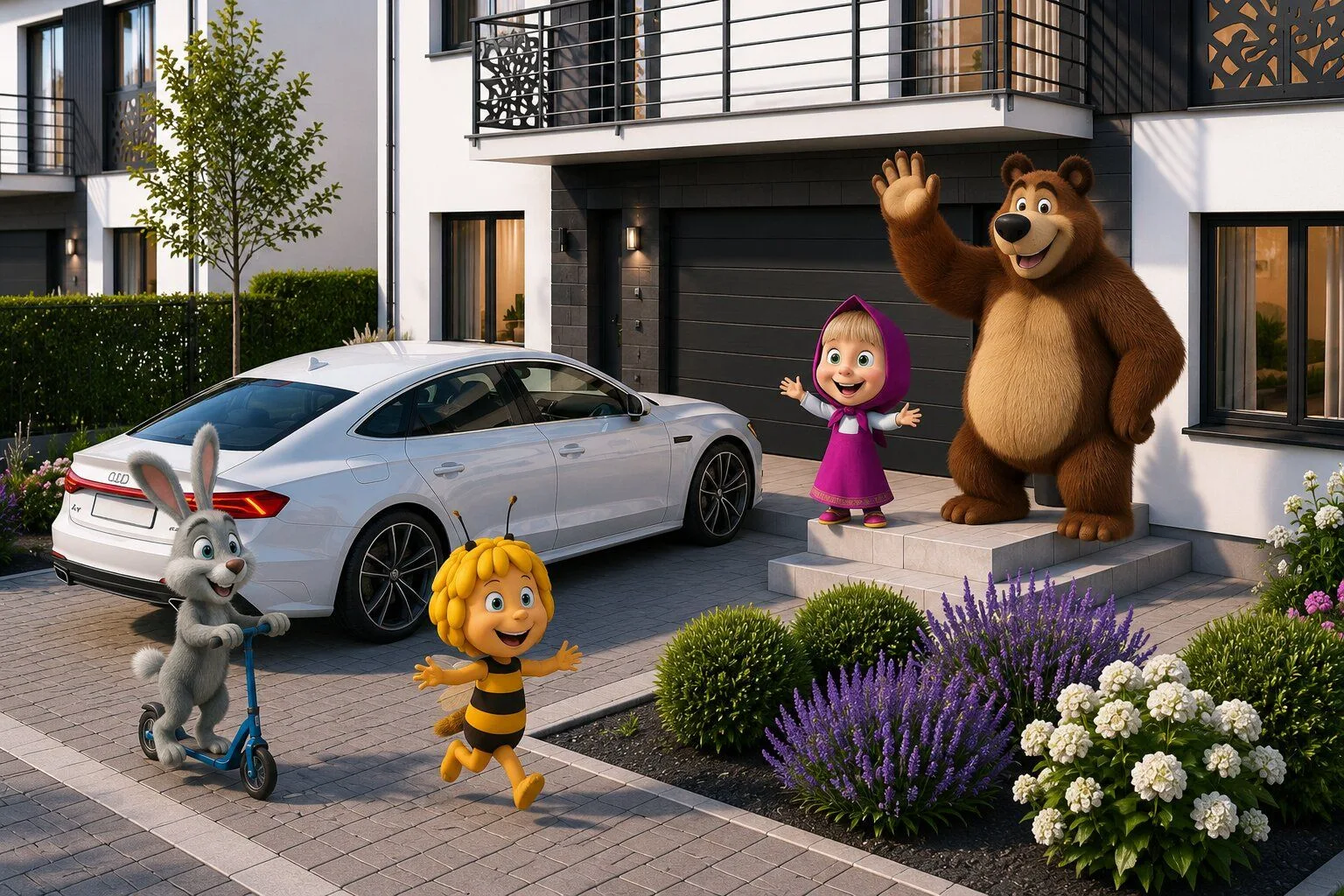
AI real estate visualizations can support sales, but they can also create unrealistic promises detached from the reality of a project. See where marketing ends and trust risk begins.
AI Renderings - When Does Marketing Become Fake Reality?
AI visualizations for real estate developers can help sell a project faster. They can also sell a version of reality that will never exist.
That is where the real risk begins.
I am not against AI. I am not against new tools. I am against using them without judgment.
AI is a tool, just like a camera, a rendering engine, a 3D model, Photoshop, video, or a drone.
The problem is not the tool. The problem is how the tool is used.
In real estate marketing, AI can help, speed up production, reduce costs, and show the mood of a project early.
It can also turn an ordinary development into a fairy-tale place with perfect light, perfect lawns, and promises the project cannot keep.
Why this matters for real estate developers
A developer is not selling square footage only. A developer is selling a decision worth hundreds of thousands or millions of dollars.
A buyer looks at a visualization and starts imagining a life: morning coffee, a quiet terrace, a child in the garden, sunlight, status, quality.
The question is simple. Does the image show the real potential of the project, or a beautiful picture detached from physics and budget?
That difference separates trust-based sales from sales built on illusion.
The beautiful-picture generator detached from physics
Many image-generation models work like beautiful-picture generators detached from physics.
The image looks great. The light is soft. The greenery is dense. People smile. The facade looks premium. The sky is perfect.
But a development does not exist in a vacuum. The building has scale. Materials have texture. Landscaping needs time.
The sun has a real path. The surrounding streets have limits. Neighboring buildings can block views. Noise and traffic do not disappear.
AI does not understand that by default. AI makes an image, and it tries to make that image attractive at almost any cost.
A human still has to protect the truth.
Where a good visualization ends and fiction begins
A good visualization helps a buyer understand the project. A bad visualization helps a buyer believe in something the project will not deliver.
Marketing can and should present a development attractively. No one expects a sales brochure to show mud, gray skies, and an empty lot in November.
But there is a line between attractive presentation and manipulation.
A good visualization says: this is what the investment can look like. A fairy-tale visualization says: this is what your life will feel like, even when the production team knows it is unlikely.
Common risks in AI visualizations for real estate developers
Mature landscaping that will realistically take years to grow.
Trees that look like a city park, while the project includes young plantings.
Unrealistic light that makes every building look like a luxury apartment tower.
Empty streets around a project located in a dense and busy urban area.
Courtyards that look larger than the architectural plan allows.
People who look like extras from a premium lifestyle campaign.
Facades without real joints, material limits, weathering, or construction details.
Terraces presented like private gardens despite limited usable area.
Views from windows that will not exist.
Missing poles, signs, cars, fences, neighboring buildings, and the normal life of the city.
Each detail may look harmless on its own. Together, they create an alternate reality.
The buyer is not buying an alternate reality. The buyer is buying a home.
A conscience clause for visualization studios
Studios creating visualizations for developers should have a conscience clause now that AI is part of the workflow.
Not as a nice slogan on a website, but as a real working rule.
For me, it means I do not turn a realistic project into a fantasy. I do not add magic where there should be architecture.
I do not hide limitations the buyer will later see in person. I do not invent views, gardens, silence, or luxury that the project cannot deliver.
That is not acting against the developer. It is protecting the developer.
A good creative partner is not only an image producer. It is a filter of common sense between sales pressure and long-term reputation.
Developers need to be careful too
The temptation is obvious. Everyone wants the strongest campaign, the best-looking visuals, and ads that stop the scroll.
But real estate sales do not end with a click. They end at handover, in a conversation with the buyer.
They end when the buyer compares the promise from the image with what was actually built.
At that point, it no longer matters that the image was beautiful. What matters is whether it was honest.
The AI hype will cool down
The market is still excited about AI. It made an image. It made it faster. It made it cheaper. It looked like a premium campaign.
That is only the first stage. Every new technology has a phase of excitement. Then comes the sober phase.
When the hype cools down, the winners will not be the people who can generate the prettiest image.
The winners will be the people who know how to use AI consciously and understand architecture, sales, buyers, and responsibility.
AI does not remove responsibility
A major mistake is thinking that responsibility becomes blurry because an image was generated by artificial intelligence.
It does not. The buyer will not talk to the model. The buyer will talk to the developer.
The buyer will not ask an algorithm why the landscaping looks different. The buyer will ask the sales team.
The buyer will not leave a review of the image generator. The buyer will leave a review of the investment.
That is why AI cannot be an excuse. It has to remain a tool under human control.
Ethical use of AI visualizations
Ethical AI visualization does not mean boring visuals. It does not mean weaker images or giving up atmosphere, light, composition, and emotion.
It means attractiveness cannot consume the truth.
The buyer should see the best version of a real project, not an unreal version of a dream.
The image should support sales without promising beyond the design, the site, the budget, or the standard.
A simple test for every visualization
Before publishing a visualization, ask one question.
Would I be comfortable if a buyer showed me this image at handover and asked where the promised elements are?
If the answer is yes, the visualization is probably safe. If the answer is no, the image went too far.
What an honest AI visualization should do
Keep the building scale realistic.
Show landscaping that matches the planting plan.
Respect the real surroundings of the investment.
Avoid views that do not exist.
Show materials in a believable way.
Preserve the logic of light and shadow.
Stay consistent with the architectural design.
Support sales without creating false expectations.
Realism does not kill sales. Realism makes sales safer.
Realistic does not mean weak
A realistic visualization does not have to be cold, boring, or technical.
It can be beautiful, emotional, atmospheric, and full of life, light, greenery, materials, and detail.
But it has to stay in contact with the truth.
A developer does not need an image that wins on Instagram. A developer needs an image that helps sell the project and does not come back as a problem at handover.
What developers gain by using AI consciously
They gain consistent communication, stronger trust, fewer buyer disappointments, better sales materials, and safer campaigns.
They gain a brand that looks professional without looking like an unsupported promise.
That is the real advantage: not the prettiest image, but the image that sells without destroying trust.
FAQ
Are AI visualizations for real estate developers bad?
No.
AI visualizations for real estate developers are not bad by default.
They are a tool like any other.
The problem begins when AI creates images detached from physics, the design, and the real standard of the investment.
Am I against AI in visualizations?
No.
I am against using AI without reflection.
AI can be a strong support tool, but it needs conscious, ethical use and human control.
What is a beautiful-picture generator detached from physics?
It is a way to describe AI models that can create attractive images without understanding the real constraints of architecture.
The image can look good while ignoring scale, light, materials, surroundings, and project logic.
What is a conscience clause in a visualization studio?
It is a working rule that the studio does not create images that knowingly mislead buyers.
It means refusing to turn a project with real design, budget, and site limits into a fantasy.
Do realistic visualizations sell worse?
No.
Realistic visualizations can sell very well because they build trust.
A good visualization should be attractive, but it should not promise things the development will not deliver.
When does an AI visualization become risky?
It becomes risky when a buyer could compare it with the finished project and feel misled.
That is the signal that the image went too far.
How can a developer use AI safely in marketing?
Treat AI as support, not as the source of truth.
Every visualization should be checked against the design, project standard, surroundings, landscaping, and real sales assumptions.
Summary
AI in real estate visualizations is not the enemy.
The enemy is excitement without control, ethics, or responsibility.
A beautiful-picture generator detached from physics can create a scene that impresses a buyer for a few seconds.
But a developer needs more than a few seconds of admiration. A developer needs trust, consistency, and materials that do not make promises without support.
AI visualizations for real estate developers should sell the truth, not a fairy tale.
Paid online consultation
Want to discuss your marketing, SEO or product idea?
You can book a paid online consultation. We will review your situation, identify practical next steps and I will tell you directly what I think is worth doing next.
No fluff. A practical conversation with clear takeaways and a founder's perspective on building online projects.
 Author: Alexander Gadomski